CONTINUAL


portable medical light
Paramedics often work through the night and are dispatched to sparsely lit areas to provide victim care. Natural disasters can damage infrastructure, requiring paramedics to administer on-site care in pitch-black environments.
While paramedic medical equipment continues to rapidly advance, supplimentary lighting technology has lagged behind. Inadequate lighting has long inhibited the productivity, efficiency, and accuracy of medical professionals.
The result of this academic assignment was a redesign of the Outask TD1 camping light to abide by a different market and constraints.
Term Project
2024
12 weeks
Carleton University
Skills
Ideation
Rendering
Woodworking
3D Printing
01 PROCESS

THE CHALLENGE
"Design a novel innovation for the medical lighting market. The resulting product will aid in the achievement of three UN Goals"
PHASE 1: GROUP RESEARCH
This project began with collaborative research between five students. Research informed on the expanse of the medical lighting industry, including product lines, environmental conditions, and user groups and desires.

PRODUCT AUTOPSY
During the autopsy process, a dental medical examination light was tested and then broken down into its components for analysis. Various features from its design were translated into the final product.


8
01. There was a motion-limiting pin for all rotating joints. This constraint ensured that internal cables do not get tangled
02. An aluminum plate, which absorbed heat generated by the LEDs (See Item 8)
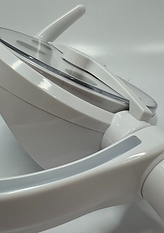


03. The light contained rubber covers for ease of assembly, disassembly, and manufacturability.
04. The cover for each LED had a refracting pattern heightening light dispersion. The six lights combined produced shadowless lighting. This is essential technology for medical lighting devices.
CURRENT MARKET PRODUCTS ANALYSIS

Portable, adjustable, stand-alone, high quality medical light
There exists a gap in the market for a durable, stationary, adjustable device that produces medical-grade light. As weather, terrain, and urgency become more extreme, products require appropriate materials of sufficient quality to allow paramedics to perform at their best.
THE UNITED NATION (UN) GOALS TARGETED BY CONTINUAL
03

09

10

GOOD HEALTH
& WELLBEING
INNOVATION & INFRASTRUCTURE
REDUCED INEQUALITIES
This goal is promoted by improving the productivity and capacity of paramedics.
Portable medical devices improve infrastructure navigability, better connecting medical professionals to those in need.
Continual lights would be distributed internationally, improving emergency response worldwide. Regions more prone to natural disasters would be prioritized for distribution.
PHASE 2: INDIVIDUAL DESIGN PROCESS
CODESIGN
Conversations with an Ottawa paramedic provided insight into the rescue process and the emotions invoked during rescues. She and her coworkers uses their phone flashlight and vehicle lights to work at night. Rescues can spike adrenaline and be extremely stressful. As such, she is susceptible to leaving supplies behind. Assessing whether a victim should be treated on-site or in a hospital takes experience.

DESIGN BRIEF
Design a portable medical lighting device for paramedics. The light should be able to light up a rescue scene in any environment. The device will enable accelerated, precise care when victims cannot be transported to an ambulance. The product must be lightweight, hands-free, and compatible with pre-existing medical equipment. Rapid setup and collapse are critical. The light must use LEDs and shadowless technology. The battery must sustain a charge for the full duration of a paramedic shift (12 hours). Lastly, the device should be intuitive and visually appealing.

SKETCH PROCESS
Through sketching, mechanisms were explored, along with clear usability indicators and form features. Pictured below is the main sketch process, which also integrates user testing feedback.
1:1 Scale Drawing


WORKING PROTOTYPE
The working prototype acted as the apparatus for user testing. It was a mixed media concept featuring PVC, wood, PLA, and a selfie stick extension pole.

Hover for information!

The light was mounted to a t-joint, with a press-fit ridge connection to the telescope, allowing for 360 degree rotation and 270 degree twisting. Lastly, the telescope was mounted to a ball joint which follows a CAM path to travel in and out of the main housing.


The completed prototype in its closed configuration, featuring a 3D printed leg system, and a PVC body encasing the light extension system.

Neccessary height and range of motion dimensions were taken using a simple prototype

The opened configuration, standing in tripod formation, with the ball joint and light mechanism directing the light to the left.

A bayonet mounting mechanism inspired the locking mechanism for the opened and closed configurations of the final light design.
USER TESTING
User testing explored variations in operating preferences. Four subjects were instructed to act as "critical care paramedics responding to the aftermath of the recent damage from a hurricane. A new lighting product was being developed to allow them to perform rescues through the night." Each subject was instructed to take different stances and set up the light in different sequences. The degree of force, length of time and mental effort required by each user was recorded.
Subject 1:
Bent Over
Subject 2:
Standing
Subject 3:
Crouching
Subject 4:
Kneeling


FINDINGS
Subject 3's product interaction was the quickest and smoothest. For the final product, I adapted the affordances to encourage product operation in this manner.
All subjects operated the product forcefully. The product needs to be highly durable and resilient.
FINALIZED CONTRAINTS
NECESSARY FEATURES


-
12 hours of light, nearly that of a full paramedic shift
-
Capacity for advanced victim care (e.g. intubation, IV insertion, cricothyrotomy, chest needle decompression...)
-
The device must balance on an uneven, sloped surface
-
Easily accessible in an emergency
-
Compatible with pre-existing equipment
-
Superior specs to current headlamps, flashlights, or other paramedic lighting equipment
-
Steady, diffuse floodlighting, such that the patient and medical equipment are clearly visible
-
Adjustable light direction
-
Waterproof
-
Rapid setup and knockdown; 20 seconds per operation maximum
-
Intuitive affordances
-
Chargeable
-
Less than 5 pounds in weight
-
Durable mechanisms and a feeling of indestructibility
-
Attractive and professional aesthetic
02 FINAL DESIGN

OVERALL DIMENSIONS AND CMF
The final model spans a maximum height of one meter and compacts to 26cm, with a diameter of 7.5cm. The colourway matches traditional first responder gear in America, with reflective tabs to provide visible affordances in all conditions. The look is heroic, which matches that of the target user.
LIGHT HEAD
Inside the aluminum telescope is a coiled wire. The wiring is soldered to a PCB with the LEDs. Lastly, there is a polycarbonate light-refracting lens. The light head can spin 350 degrees and rotate 180 degrees.


MAIN BODY
The main body features the power button, a battery indicator, and encases the telescope. In the mid-section, the tracks with a bayonet mount on either end allow the tripod ring to travel between open and closed configurations. The bottom compartment contains the batteries.


TRIPOD RING
The tripod ring slides inside the grooves of the main body and rests against the battery casing via the tripod legs at a 45° angle. This robust system requires no springs. When closed, the magnets on the legs attract to those on the main body, closing the tripod. The reflective arrows align when the system is unlocked, directing ease of use. Leg axes rotate around dowel pins, which are inserted through the pictured opening, covered by a translucent rubber cap.
TRIPOD LEGS
The tripod legs use a CONTINUAL patterned support, as well as rubber feet for improved traction on slippery surfaces.

Pictured here is the closed configuration. Designed to be highly compact during transportation. There is a rope for carabiner attachment, which makes it easy to integrate the light with existing medical gear when not in use.
CLOSED CONFIGURATION
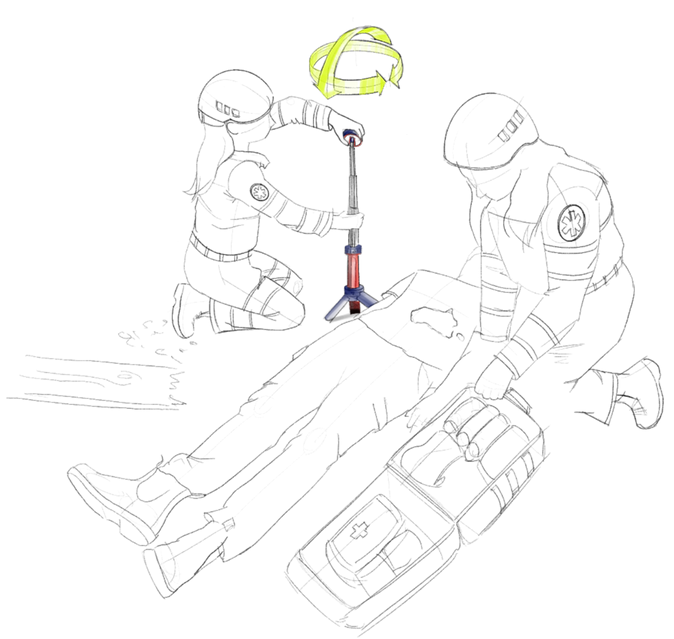
USE CYCLE
01

Unclip the light from the equipment once the victim is identified

02
Extend the telescope
03
Turn on the light, take note of the battery life
04
Twist to unlock the light from its closed configuration
05
Release the tripod, and twist again to lock into its opened position


06
Configure the light head to direct the light towards the desired area of focus. The floodlight illuminates both the affected area and the medical equipment


PHYSICAL MODEL
The physical model provided scaling for presentation. It can be tangibly visualized in the field. The model is composed of PLA, high-density foam, wood, PVC, bent acrylic, and engraved clear plastic. Two small LEDs were inserted under the plastic to display the light capability. The resulting parts were spray-painted using a water-based mixture.